Why Timed Practice Is Your Best Defense Against Exam Anxiety
When the Clock Becomes Your Biggest Classroom Enemy
Every student knows that specific, hollow feeling in their chest when they turn over an exam paper and realize the time is already ticking away. It is not necessarily the difficulty of the questions that causes the most distress, but the pressure of the countdown itself. Whether you are prepping for the HKDSE, IB, or A-Levels, the environment of a real exam is an artificial construct that few students practice enough. We spend hours reading textbooks and highlighting notes, yet we rarely simulate the exact physical and mental constraints of the exam hall until it is far too late.
This isn't just about knowledge; it is about the biology of stress. When you are unfamiliar with the pace required to complete a paper, your brain enters a state of fight-or-flight, which actively inhibits your ability to recall information. It is a cycle of anxiety that breeds more anxiety. By bringing the clock into your study sessions now, you aren't just practicing questions—you are desensitizing your nervous system to the very pressure that makes students feel as though their future is on the line.
The Rising Pressure of Global Education Standards
The stakes for students in 2026 feel higher than ever. From the headlines regarding university admissions investigations at schools like William & Mary to the ongoing debates about whether universities are truly keeping pace with a shifting job market, the pressure to 'get it right' the first time is immense. When headlines suggest that top-tier universities are becoming more selective, as seen in the latest UK admissions data, it is no wonder that parents and students alike are reaching a breaking point.
This anxiety is felt in every region, whether it is Indian students protesting the lack of job-ready curriculum or parents in the UK struggling with the mounting costs of essential school supplies. When the world feels unpredictable, the exam hall feels like the only place where you can prove your worth. However, that mindset is exactly what feeds the panic. When we treat every practice test as a high-stakes life event, we burn out before the actual exam ever begins.
Moving Beyond Passive Reading to Active Simulation
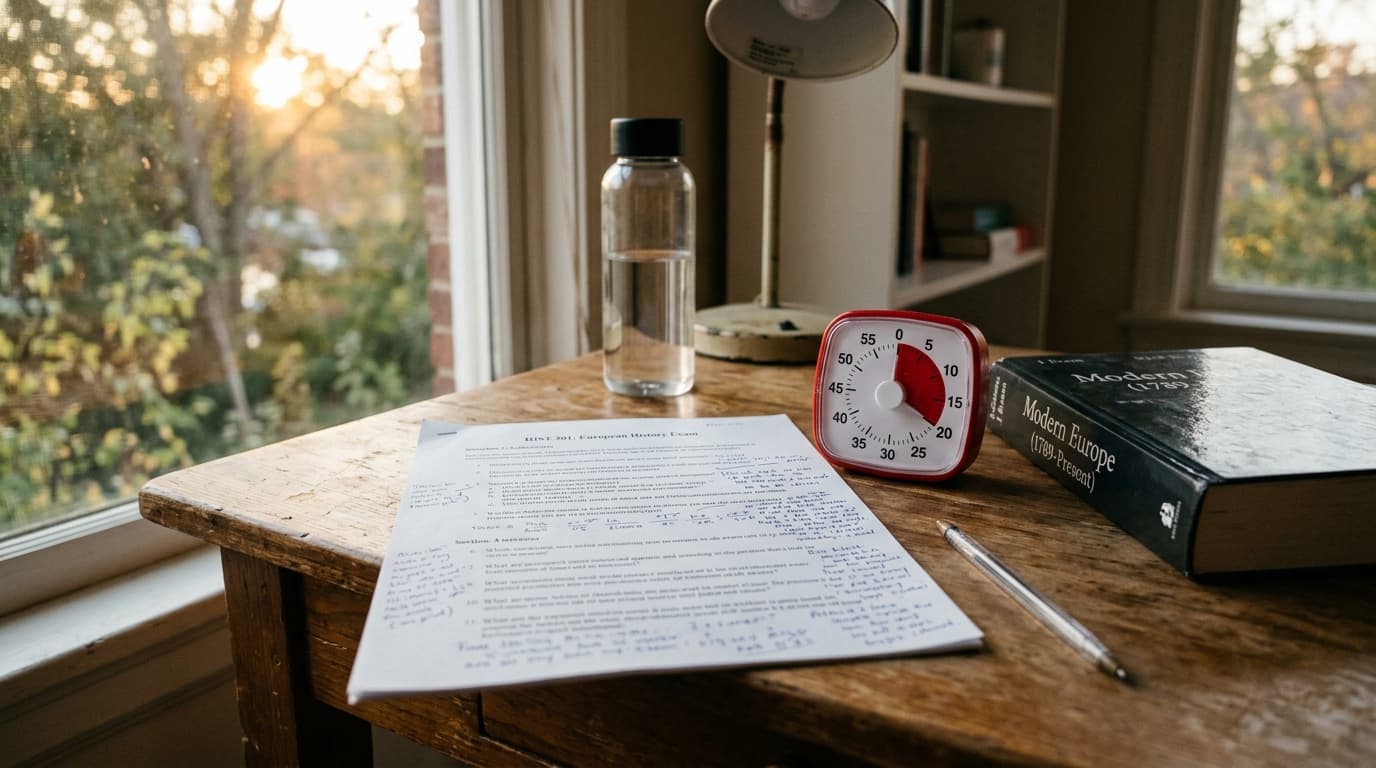
If your current revision looks like reading a chapter and highlighting paragraphs, you are doing too much 'passive' work. Passive revision feels productive because it is comfortable, but it does nothing to prepare you for the cognitive load of a timed exam. This week, start by taking one past paper section—like a single Paper 2 physics problem set or a biology data analysis question—and set a strict timer. Do not touch your notes. Do not check your phone. If you get stuck, force yourself to make an educated guess and move on, just as you would in the real exam.
After the timer goes off, evaluate your performance not by what you got right, but by where you hesitated. Did you get stuck on the wording? Did you lose focus because of a distraction? When you treat practice as a simulation of the exam experience rather than a test of your memory, you stop fearing the clock. You start to see it as a tool that helps you pace your thoughts, rather than a weapon designed to expose your weaknesses.
How Parents Can Help Without Adding to the Load
Parents often feel helpless during revision periods, leading them to either hover or disengage entirely. Instead of asking 'Have you finished your work?'—which usually just triggers a defensive response—try acting as the 'exam proctor.' Offer to set up a dedicated workspace where phones are placed in another room, and let them know you are timing a 45-minute block. When the time is up, walk away. Don't ask to see the score immediately. Give the student space to self-assess first.
The goal is to create a predictable routine. If a student knows that they have a set time for deep, focused, timed work followed by a set time for rest, they are much less likely to spiral into late-night panic sessions. By providing the structure, you remove the burden of decision-making from the student, allowing them to focus entirely on the academic task at hand.
Why You Must Stop Chasing Perfect Revision Conditions
The most common myth in student life is that you need to be 'perfectly prepared' before you can handle a timed test. Many students wait until the very end of their revision cycle to start using past papers, convinced that they need to memorize every single page of their notes first. This is a fatal mistake. You should be using timed practice to identify your knowledge gaps, not to prove how much you have already learned. If you wait until you feel ready, you will never feel ready.
Another mistake is 'cherry-picking' easy questions. It feels good to get a high score on a practice paper, but if you are only doing the questions you find easy, you are essentially just comforting yourself. A true practice session should be slightly uncomfortable. If you aren't finding the time constraint challenging, you aren't pushing your brain to develop the necessary speed and accuracy required for the final assessment.
Simplicity as a Strategy for Success
Consistency beats intensity every single time. By integrating short, timed bursts of activity into your daily schedule, you build a mental muscle that keeps anxiety at bay when the exam timer finally starts for real. Tools like Revui allow you to generate these focused, time-bound challenges with precision, ensuring your practice is always aligned with the specific requirements of your syllabus without the overhead of planning it yourself.
Further reading
- DOJ Targets William & Mary in Latest Race-Based Admissions Investigation — Inside Higher Ed
- India’s student protests exposed deeper anxieties over education and jobs as AI reshapes work — Channel NewsAsia
- Philippine school shooter kills fellow student and himself in livestreamed attack — The Guardian Asia-Pacific
- Education, health fees among key concerns — China Daily
- Minecraft workshops build understanding of cityscapes before atomic bombings — The Japan Times