Supporting Your Child Through Exam Season Without Micromanaging
When the Kitchen Table Becomes a War Room
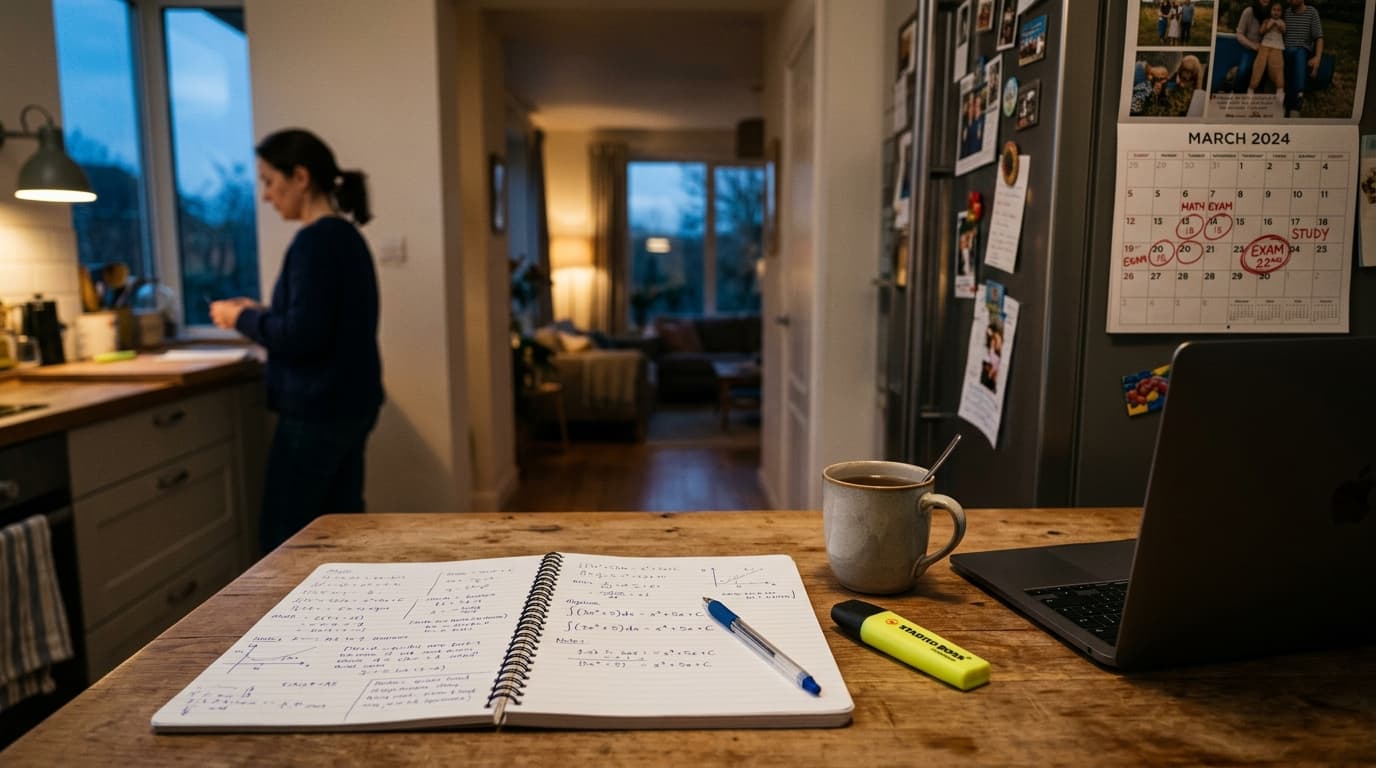
It starts on a Tuesday evening. Your child is hunched over a pile of past papers, their phone screen glowing intermittently with messages that aren't about calculus. You walk past, see the chaotic scribbles on the page, and feel that familiar, sharp urge to intervene. Should you suggest a better schedule? Ask why they are still on Chapter 4? Remind them that their university prospects depend on the next six weeks? If you find yourself hovering, you are not alone; many parents feel that their own anxiety is merely a mirror of the pressure their children are under.
The reality is that the modern student's life is increasingly detached from the old playbook of parental oversight. As we see in reports from Hong Kong, the traditional model of shuttling children between endless tutoring sessions is increasingly being questioned as ineffective. When we turn the home into a secondary classroom, we often strip the student of the one thing they need most: the ability to own their own academic process.
The New Reality of Academic Pressure
The landscape is shifting beneath our feet. From the tightening of international student restrictions in the U.S. to the ongoing debates about which degrees will actually remain 'AI-resistant,' the stakes feel higher than ever. Students are hearing these headlines, too. They are aware of the falling birth rates and the fierce competition for university spots, even as they struggle with the same universal teenage challenge: showing up when they simply don't want to.
We are seeing a trend where students might be enrolled in prestigious programmes but are effectively 'missing' from their own education, drifting through the motions without true engagement. This isn't just about laziness; it’s about a loss of agency. When parents take on the role of 'Chief Exam Officer,' the student stops being the primary driver of their learning and becomes a passive participant in their own success—or failure.
Concrete Steps for the Student in Your Life
If your child is currently struggling to focus, stop asking 'Are you studying?' and start asking 'What is the friction point?' A student who is stuck on a specific mechanics problem in Physics doesn't need a reminder to study; they need to know how to break that specific concept down. Encourage them to use active recall—closing the book and explaining the concept aloud—rather than re-reading notes, which is a common but largely ineffective way to kill time.
Suggest that they dedicate specific 'sprints' to their work. Instead of telling them to 'do some work for an hour,' suggest they aim to finish three specific exam-style questions. When the goal is small and measurable, the anxiety of the 'massive pile of work' shrinks. This gives them a quick win, which is often the best antidote to the paralysis that sets in during high-stakes preparation.
How to Pivot from Manager to Anchor
Parenting during exams should feel less like being a coach and more like being a pit crew. Your job isn't to drive the car; it's to keep the car running so the driver can do the racing. This means focusing on the basics: consistent sleep patterns, access to decent food, and a home environment that doesn't feel like a constant interrogation.
If you catch yourself about to micromanage, pause. Instead of correcting their revision timetable, ask, 'Do you have everything you need to be effective tonight?' or 'Is there a topic that feels like a brick wall right now?' By shifting the focus to providing resources—like high-quality practice questions or a quiet space—you move from being the person they are hiding from to the person they can rely on when they hit a wall.
Common Pitfalls and the Myth of Perpetual Productivity
One of the biggest mistakes parents make is assuming that 'more time' equals 'better results.' We fall into the trap of believing that if they are at their desk, they are learning. But a student staring at a textbook for three hours while worrying about a social media feed is not revising. It is better to have one hour of intense, focused, and guided practice than four hours of passive, distracted sitting.
Avoid the temptation to compare their progress to their peers or to their own past performance in a way that feels punitive. The goal isn't to achieve a perfect score on every practice set; the goal is to identify gaps and close them. If they get a question wrong, treat it as useful data rather than a moral failing. Framing mistakes as 'diagnostic information' helps lower the temperature in the house significantly.
Staying Grounded in the Long Run
Ultimately, the goal is to help your child develop the self-regulation they will need long after the exam results are published. Using tools like Revui can help by providing structured, targeted practice that allows students to diagnose their own weaknesses, giving you both the data you need to stay calm and the confidence that they are making progress, one question at a time.